



Cost–Benefit Assessment Module
The Cost–Benefit Assessment Module includes submodules for emission reduction cost accounting, climate effect assessment, health effect assessment, and resource effect assessment. Its main function is to estimate emission reduction costs, climate effects, health effects, and resource effects under different emission pathways, and to evaluate their overall costs and benefits.
The Cost–Benefit Assessment Module uses the independently developed Dynamic Emission Mitigation Cost model to estimate the integrated emission reduction costs under different emission pathways. The climate effect assessment includes two components: temperature effect assessment and radiative effect assessment. The temperature effect assessment estimates the carbon emissions budget locked in by the existing stock of emission sources and evaluates the resulting temperature effects. The radiative effect assessment evaluates aerosol–radiation effects, also known as direct effects, and cloud–radiation effects, also known as indirect effects, based on simulated changes in atmospheric aerosol concentrations under different pathways.
The health effect assessment uses pollution exposure–response models to estimate population health losses associated with air pollution exposure under different pathways. The resource effect assessment includes two components: renewable energy resource effects and critical mineral resource effects. On the one hand, it evaluates changes in the spatial distribution of wind and solar resources under future climate change and assesses the reliability of power systems with high shares of renewable energy. On the other hand, it analyzes the demand for renewable energy and the corresponding industrial scale under different emission reduction pathways. Based on this analysis, it further evaluates the demand for critical mineral resources and supply chain security associated with the large-scale development of renewable energy industries.
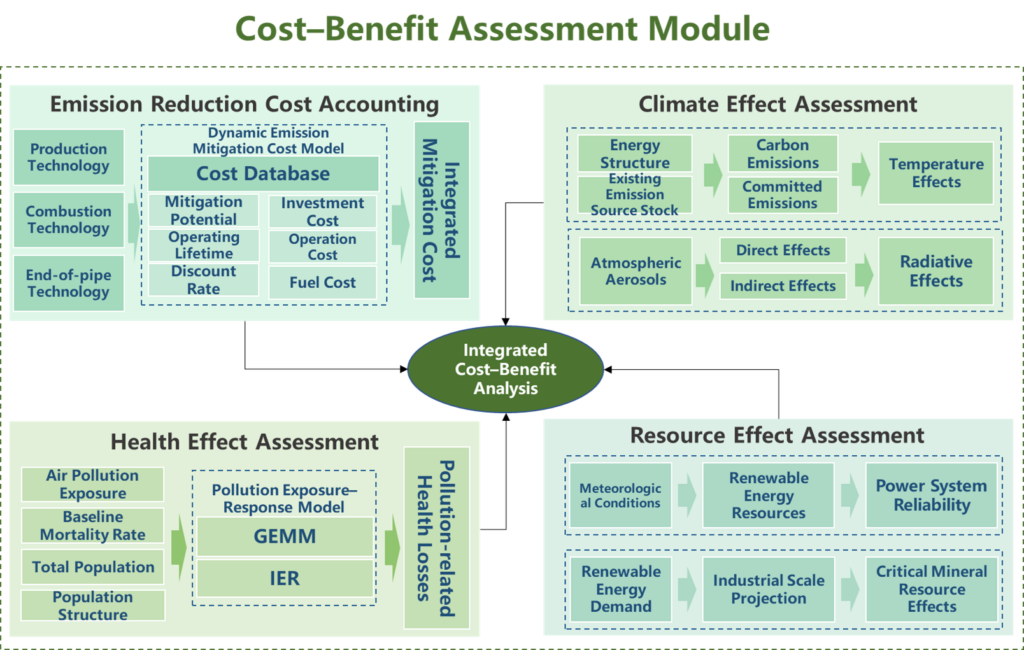
Figure 1. Technical framework of the Cost–Benefit Assessment Module
References:
- Tong D, Zhang Q, Zheng Y, Caldeira K, Shearer C, Hong C, Qin Y, Davis SJ. Committed emissions from existing energy infrastructure jeopardize 1.5 C climate target. Nature. 2019 Aug 15;572(7769):373-7. [Link]
- Hong C, Zhang Q, Zhang Y, Davis SJ, Zhang X, Tong D, Guan D, Liu Z, He K. Weakening aerosol direct radiative effects mitigate climate penalty on Chinese air quality. Nature Climate Change. 2020 Sep;10(9):845-50.[Link]
- Tong D, Farnham DJ, Duan L, Zhang Q, Lewis NS, Caldeira K, Davis SJ. Geophysical constraints on the reliability of solar and wind power worldwide. Nature communications. 2021 Oct 22;12(1):6146. [Link]
Dynamic Emission Mitigation Cost Model (DEMC)>
The Dynamic Emission Mitigation Cost model (DEMC) estimates the integrated costs of different emission reduction pathways based on the investment costs, operation and maintenance costs, and fuel costs of various mitigation technologies, together with their emission reduction potential and operating lifetimes. The DEMC model calculates costs based on pollutant emission reductions and unit costs across different emission reduction rate ranges. It characterizes the integrated costs associated with technological transitions under different emission reduction pathways, and can analyze dynamic changes in mitigation costs at multiple levels, including control technologies, sectoral measures, and emission reduction pathways.
The Dynamic Emission Mitigation Cost model is currently under further development and improvement, and will be released in the future.
Health Effect Assessment>
This module uses pollution exposure–response models to estimate population health losses associated with air pollution exposure. The models used include the Integrated Exposure–Response model (IER) and the Global Exposure Mortality Model (GEMM).
Integrated Exposure–Response Model (IER)
The Integrated Exposure–Response model (IER) is the pollution exposure–response model used in the Global Burden of Disease (GBD) study. It is used to estimate the health burden associated with ambient PM2.5 exposure among populations aged 25 years and older. Early versions of the IER model selected ischemic heart disease, chronic obstructive pulmonary disease, lung cancer, lower respiratory infection, and stroke as health endpoints.
Due to the lack of cohort studies under high PM2.5 concentration exposure, the model adopts an equal-toxicity assumption and incorporates concentration exposures from smoking and household solid fuel use into the construction of the exposure–response relationship. The latest version of the IER model adds type 2 diabetes as a health endpoint, uses more flexible spline functions for fitting, and establishes a new method for constructing PM2.5 exposure–response curves, known as MR-BRT. The methodology and relevant parameters of the IER model can be found on the GBD 2019 website.
Global Exposure Mortality Model (GEMM)
The Global Exposure Mortality Model (GEMM) is a model developed by Richard Burnett and colleagues to assess the disease burden associated with PM2.5 exposure. GEMM integrates 41 cohort studies from 16 countries, including cohorts with high PM2.5 exposure in China. Based on these data, it establishes a new risk assessment method and provides exposure–response relationships for all-cause mortality, enabling a more accurate characterization of mortality risks from ambient PM2.5 pollution among highly exposed populations. For detailed information about GEMM, please refer to the relevant publications.