



Emission Pathway Simulation Module
The Emission Pathway Simulation Module dynamically projects the future supply–demand landscape of energy and resources, and the multi-medium, multi-species emissions of atmospheric constituents, under user-defined scenarios. The module comprises three components: an Energy–Resource Model, a Dynamic Projection model for Emissions in China (DEPC), and the Multi-resolution Emission Inventory for Climate and air pollution research (MEIC) model. By specifying alternative socio-economic development pathways and climate–environment policy targets, the module simulates the spatio-temporal evolution of energy demand, energy supply, mineral resource supply and demand, the structure of industrial technologies, and product output, as well as the spatio-temporal distribution of greenhouse gas, criteria air pollutant, and toxic substance emissions. The module provides emission inputs to the Pollution Exposure Simulation Module and supplies future technology structure, carbon emission trajectories, and critical mineral supply–demand parameters to the Cost-Benefit Assessment Module.
The Energy–Resource Model component consists of an integrated assessment model and a resource assessment model: the former adopts GCAM-China, the China-nested version of the global integrated assessment model GCAM, while the latter is developed in-house. GCAM-China is used to simulate provincial-scale changes in product/service supply and energy consumption across scenarios, and the resource assessment model is used to project the future availability of solar, wind, and mineral resources. DEPC, also developed in-house, takes the projected energy, product/service, and mineral supply–demand as inputs and, by combining facility-scale technological turnover with sector-level technology forecasting, simulates the dynamic spatio-temporal distribution of multi-medium, multi-species emissions under different scenarios. The MEIC model provides the overall computational framework and online technical platform for the module: it supports the construction of the emission source classification and accounting system, enables the coupling and parameter exchange between GCAM-China and DEPC, and supplies the baseline-year activity levels, emission characteristics, technology distributions, and pollution control parameters required by the module.
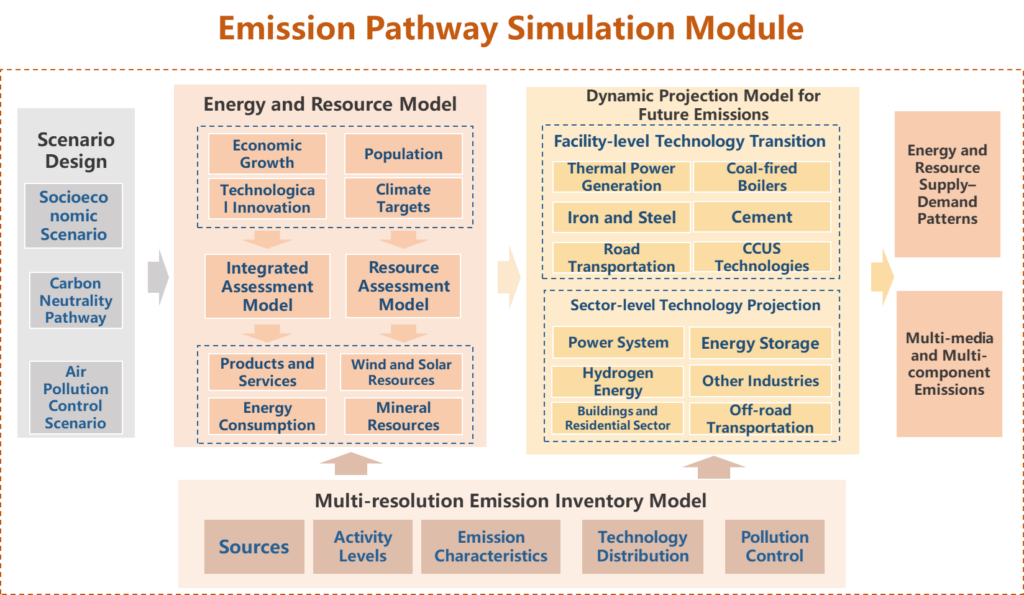
Figure 1. Technical roadmap of the Emission Pathway Simulation Module.
Integrated Assessment Model — GCAM-China>
The integrated assessment model adopted in this module is GCAM-China, a China-province-nested version of the Global Change Analysis Model (GCAM). GCAM, developed and maintained by the Pacific Northwest National Laboratory (PNNL), is a global integrated assessment model that explicitly represents the behavior of – and the complex interactions among – the socio-economic, energy, water, agricultural and land-use, and climate systems. GCAM is one of the flagship integrated assessment models used by the IPCC in successive assessment reports and is one of the anchor models underlying the RCP/SSP scenario framework; it is widely used in scenario analysis of global and regional energy transition and climate mitigation. Building on the global GCAM, the Chinese team — in collaboration with PNNL — developed GCAM-China to enable provincial-scale analysis of socio-economic pathways, energy supply and demand, and emission trajectories in China under climate change. In GCAM-China, China's provinces participate in global carbon markets as independent actors, and energy supply, energy consumption, product output, and technology turnover are projected at the provincial level under alternative socio-economic pathways and climate targets. The model is used to construct the future energy supply–demand and emission landscape and to formulate mitigation strategies that are internally consistent from the global to the national and provincial scales.
The CNCAP team has a long-standing collaboration with the GCAM development team and has been deeply involved in the development of GCAM-China. The team's contributions include, on the one hand, structural improvements to the model to support a more detailed representation of multi-sector, multi-industry carbon-neutrality technology roadmaps; and on the other hand, the coupling of GCAM-China with the in-house MEIC model, which establishes a hybrid bottom-up technology-turnover + top-down system methodology for projecting future air pollutant emissions under carbon-peak and carbon-neutrality pathways.
Detailed documentation and source code of GCAM are available on the [GCAM website]. The latest open-source release, GCAM-China v8, can be downloaded from the [Link].
Dynamic Projection Model for Emissions in China (DPEC)>
DEPC is the core component of the Emission Pathway Simulation Module, designed to dynamically project future emission changes through technology evolution simulation. The model inherits the historical technology turnover trajectories of more than 700 emission source categories from MEIC, on the basis of which it constructs facility-scale and sector-scale technology turnover sub-models. Under alternative socio-economic development and policy scenarios, DEPC simulates the technology evolution of each emission source category and the resulting emission trajectories. For coal-fired power generation, the iron & steel industry, the cement industry, coal-fired boilers, and on-road transportation, facility/fleet-scale technology turnover models are applied to simulate the turnover of physical units and the associated emission changes; for all other sources, sector-scale technology turnover models are used to simulate technology evolution and emission changes at the provincial level.
DEPC interfaces seamlessly with GCAM-China by mapping the future energy supply–demand projections from GCAM-China — generated under alternative Shared Socio-economic Pathways (SSPs) and Representative Concentration Pathways (RCPs) — onto DEPC's technology turnover sub-models for individual emission source categories. This integration enables fine-grained simulation of future emissions of atmospheric constituents in China under a wide range of socio-economic and climate policy scenarios. Through the MEIC online technical platform, DEPC provides on-line computation and download of gridded emission data for atmospheric constituents in China under each scenario, in a data format consistent with MEIC's standard products.
Detailed documentation of DEPC is available on the [MEIC website]. The model currently provides three sets of emission scenario datasets, all of which can be downloaded from the MEIC website.
References:
- Tong, D., Cheng, J., Liu, Y., Yu, S., Yan, L., Hong, C., Qin, Y., Zhao, H., Zheng, Y., Geng, G., Li, M., Liu, F., Zhang, Y., Zheng, B., Clarke, L., and Zhang, Q.*: Dynamic projection of anthropogenic emissions in China: methodology and 2015–2050 emission pathways under a range of socio-economic, climate policy, and pollution control scenarios, Atmos. Chem. Phys., 20, 5729–5757, 2020. [Link]
- Cheng, J., Tong, D. , Zhang, Q. , Liu, Y., Lei, Y., Yan, G., Yan, L., Yu, S., Cui, R. Y., Clarke, L., Geng, G, N., Zheng, B., Zhang, X, Y., Davis, J, S., and He, K, B.: Pathways of China’s PM2.5 air quality 2015–2060 in the context of carbon neutrality, Natl. Sci. Rev., nwab078, 2021. [Link]
Multi-resolution Emission Inventory for Climate and Air Pollution Research(MEIC)>
MEIC (Multi-resolution Emission Inventory for Climate and air pollution research) is an anthropogenic atmospheric emission modeling platform evolved from the Multi-resolution Emission Inventory for China, which has been developed and maintained by Tsinghua University since 2010. The platform is designed to build a high-resolution, global, multi-scale anthropogenic emission inventory for greenhouse gases and air pollutants, and to share data products with the scientific community through a cloud-computing platform, providing foundational emission data support for scientific research, policy assessment, and air quality management. The model delivers gridded anthropogenic emission data at multiple scales, worldwide, through its online data platform.
Detailed documentation of the MEIC model and its data products is available on the [MEIC website]. The historical emission data required for CNCAP platform simulations can be downloaded from the MEIC website.
Reference:
- Zheng, B., Tong, D., Li, M., Liu, F., Hong, C., Geng, G., Li, H., Li, X., Peng, L., Qi, J., Yan, L., Zhang, Y., Zhao, H., Zheng, Y., He, K., and Zhang, Q.: Trends in China’s anthropogenic emissions since 2010 as the consequence of clean air actions, Atmos. Chem. Phys., 18, 14095-14111, doi: 10.5194/acp-18-14095-2018, 2018.[链接]