


Since 2013, China has made remarkable achievements in air pollution control. However, PM2.5 pollution remains severe, with annual average concentrations still more than six times higher than the World Health Organization guideline value, posing serious risks to public health. As population aging continues to intensify, air pollution will pose an even greater threat to vulnerable populations, making sustained air quality improvement increasingly necessary and urgent. Since greenhouse gases and air pollutants largely originate from the same sources, climate change mitigation policies can deliver substantial air quality and health benefits. After China announced its carbon peaking and carbon neutrality goals in 2020, implementing synergistic pathways for carbon neutrality and clean air has become a major policy option for further improving air quality in China.
To reasonably characterize future changes in atmospheric species emissions in China under pathways for carbon peaking, carbon neutrality, and clean air synergies, the MEIC team developed the Dynamic Projection model for Emissions in China (DPEC). Through collaboration with the GCAM modeling team at Pacific Northwest National Laboratory in the United States, the team was deeply involved in the development of the GCAM-China model and improved its model structure to provide a detailed representation of carbon neutrality technology pathways across multiple sectors and industries. The team also coupled GCAM-China with the MEIC model, establishing a method that combines bottom-up technology transition modeling with top-down optimization modeling. This approach addresses the problem that integrated assessment models tend to predict excessively early and rapid near- and medium-term emission reductions under low-emission pathways, making it difficult to simulate China’s carbon peaking pathway. The improved framework enables more reasonable projections of near- and medium-term emission pathways.
Based on these methodological improvements, the MEIC team recently completed the development of DPEC v1.2 scenarios, constructing five emission reduction scenarios with different levels of ambition for pathways toward carbon peaking, carbon neutrality, and clean air synergies. All five scenarios are driven by the SSP1 socioeconomic pathway. They are as follows:
Baseline: No new carbon mitigation or air pollution control measures are implemented in the future.Clean Air: Strict end-of-pipe air pollution control measures are implemented in the future, but no new carbon mitigation measures are introduced.On-time Peak–Clean Air: Carbon emissions peak before 2030, but no new carbon mitigation measures are implemented after 2030. Strict end-of-pipe air pollution control measures are implemented synergistically from 2020 to 2060.On-time Peak–Net Zero–Clean Air: Carbon emissions peak before 2030 and carbon neutrality is achieved before 2060, while strict end-of-pipe air pollution control measures are also implemented.Early Peak–Net Zero–Clean Air: Carbon emissions peak earlier than scheduled and carbon neutrality is achieved before 2060, while strict end-of-pipe air pollution control measures are also implemented.

Figure 1. Changes in major air pollutant emissions in China from 2020 to 2060 under DPEC scenarios v1.2
he DPEC v1.2 scenario dataset covers the period from 2020 to 2060, with 2020 as the base year. Emissions in 2020 are consistent with those in MEIC v1.4. The DPEC v1.2 data can be downloaded from the MEIC website: http://meicmodel.org.cn
To facilitate comparison, the MEIC team also provides simulated future PM2.5 concentration data for China under the five scenarios, together with the corresponding CMAQ model configuration parameters. These data can be downloaded from the website of the Carbon Neutrality and Clean Air Synergetic Platform for Scientific Assessment and Decision Support (CNCAP):http://cncap.org.cn
Detailed information on the DPEC v1.2 scenarios can be found in the team’s recent article published in One Earth, titled “A synergistic approach to air pollution control and carbon neutrality in China can avoid millions of premature deaths annually by 2060.” Article link: https://doi.org/10.1016/j.oneear.2023.07.007
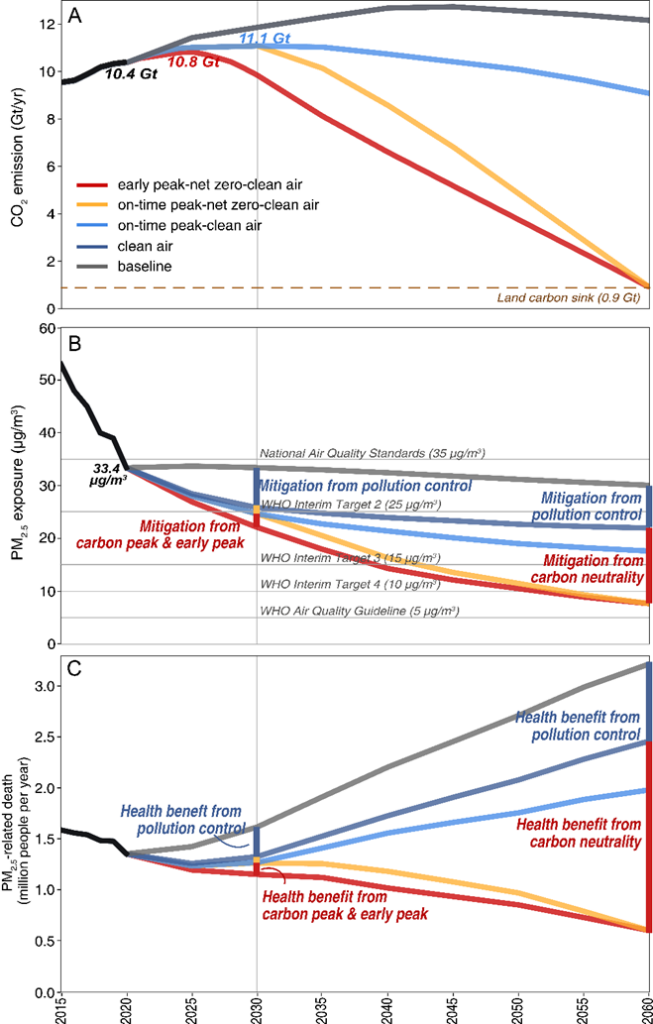
Figure 2. Changes in carbon emissions, PM2.5 exposure levels, and related premature deaths in China under different scenarios
The core function of the DPEC model is the dynamic simulation of future emission changes based on technology transitions. On the one hand, it integrates the historical technology transition processes of more than 700 emission sources in the MEIC model, and uses these data to simulate future technological evolution across different pollution sources and its impacts on emissions under different socioeconomic development and policy scenarios. On the other hand, it is seamlessly linked with GCAM-China, the China-nested version of the global integrated assessment model GCAM. Future energy demand and supply scenarios under socioeconomic pathways (SSPs) and climate target constraints (RCPs) are mapped one by one to technology transition models for different pollution sources. This enables refined simulation of future atmospheric species emissions in China under different socioeconomic scenarios and climate target constraints. Finally, by linking with the Multi-resolution Emission Inventory Reanalysis and Data Sharing Platform, the DPEC model provides online gridded atmospheric species emission data for China under different future scenarios. The data format is consistent with that provided by the MEIC model.